Why Learn DevOps? (Benefits, Skills, and Career Paths)

DevOps is no longer optional—it’s the backbone of modern software delivery.
This post explains why learning DevOps is worth your time, what skills you’ll gain, and how it shapes your career.
What you’ll learn in this post
- Why DevOps exists (and what problems it solves).
- The real-world benefits of DevOps for teams & companies.
- Core skills and tools you’ll master when learning DevOps.
- Career opportunities and job market demand.
- A practical learning roadmap to get started.
Note: This article is written in plain Markdown/MDX. You can extend it with JSX if you want (charts, callouts, embeds), but it works perfectly in Docusaurus as-is.
1) What is DevOps, really?
At its core, DevOps is a culture + set of practices that integrates development (Dev) and operations (Ops) to shorten the software delivery lifecycle.
Instead of working in silos, DevOps teams collaborate to plan, build, test, deploy, and monitor software continuously.
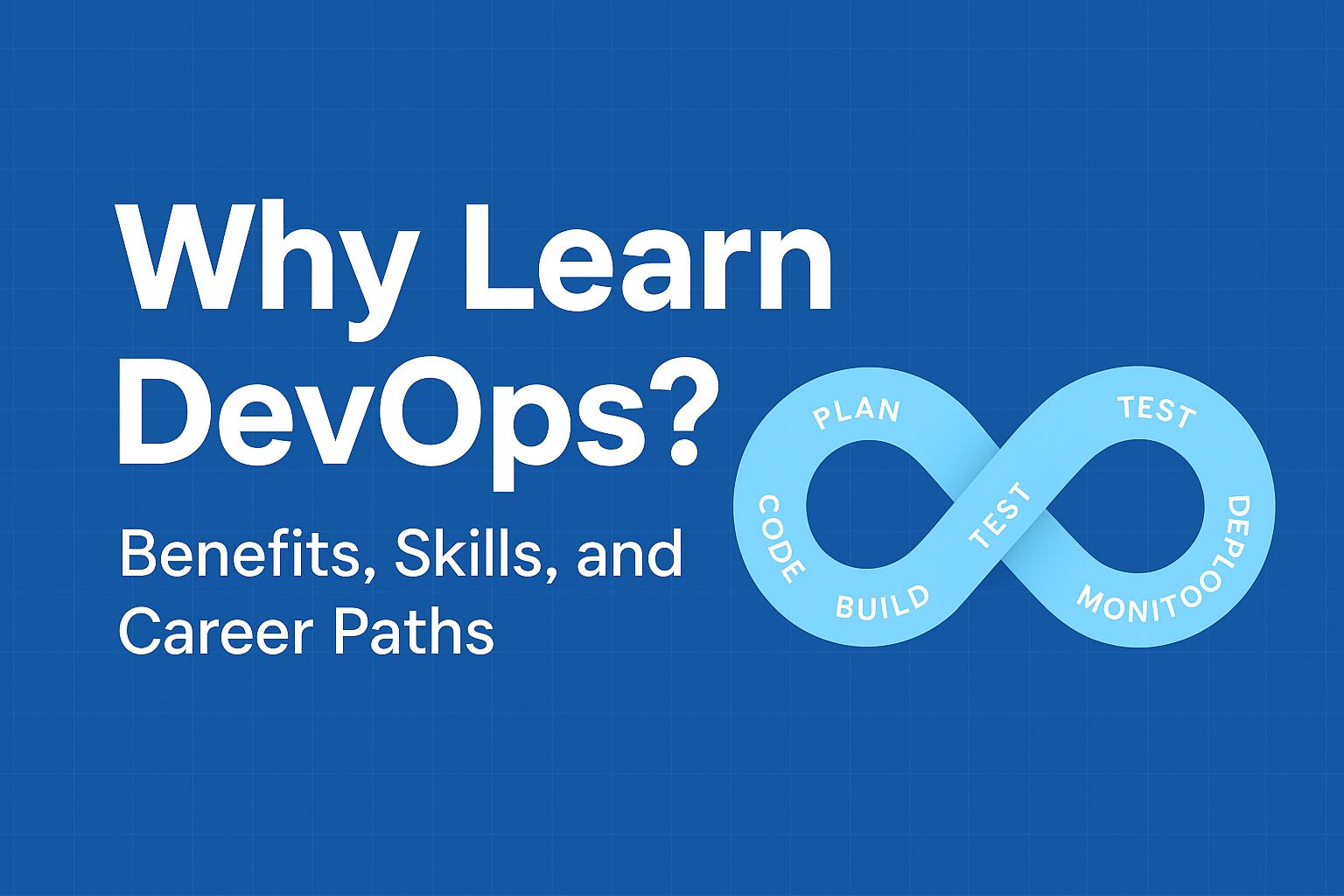
Figure: The DevOps lifecycle—continuous improvement at every stage.
2) Why learn DevOps?
🚀 Faster delivery
DevOps enables rapid releases without sacrificing stability.
🛠 Better collaboration
Bridges the gap between dev, QA, and ops teams—reducing friction.
⚡ Automation everywhere
From testing to deployment, repetitive tasks are automated.
📈 High demand in the job market
Companies across industries are adopting DevOps as a standard.
3) Key skills you’ll gain
| Skill Area | Why It Matters | Example Tools |
|---|---|---|
| Version Control | Track and manage code changes | Git, GitHub, GitLab |
| CI/CD Pipelines | Automate testing and deployment | Jenkins, GitHub Actions |
| Containerization | Portable, scalable app environments | Docker, Podman |
| Orchestration | Manage large clusters of containers | Kubernetes, OpenShift |
| Cloud Platforms | Deploy and scale in the cloud | AWS, Azure, GCP |
| Monitoring & Logs | Detect issues early, improve reliability | Prometheus, Grafana, ELK |
Start with Git + Docker + a CI/CD tool (like GitHub Actions).
You’ll learn faster by building a small project pipeline.
4) Career opportunities
DevOps isn’t a single job—it’s a career path with multiple roles:
- DevOps Engineer → Focus on automation, CI/CD, monitoring.
- Cloud Engineer → Specialize in AWS, Azure, or GCP deployments.
- SRE (Site Reliability Engineer) → Keep systems reliable & scalable.
- Platform Engineer → Build and manage internal DevOps platforms.
💡 According to job market reports, DevOps engineers rank among the top 5 highest-paid IT roles globally.